Imagine trying to repair a broken camera nearly 600 million kilometers away from Earth. No toolbox, no technician, just remote commands and creative thinking. That’s exactly what NASA did when JunoCam—the camera on board the Juno spacecraft orbiting Jupiter—started failing. With no way to physically fix it, NASA scientists used an extreme thermal technique to bring the camera back to life. And surprisingly, it worked.
Let’s break down how they pulled off this space repair miracle and why it’s such a big deal for the future of space missions.
Table of Contents
Juno

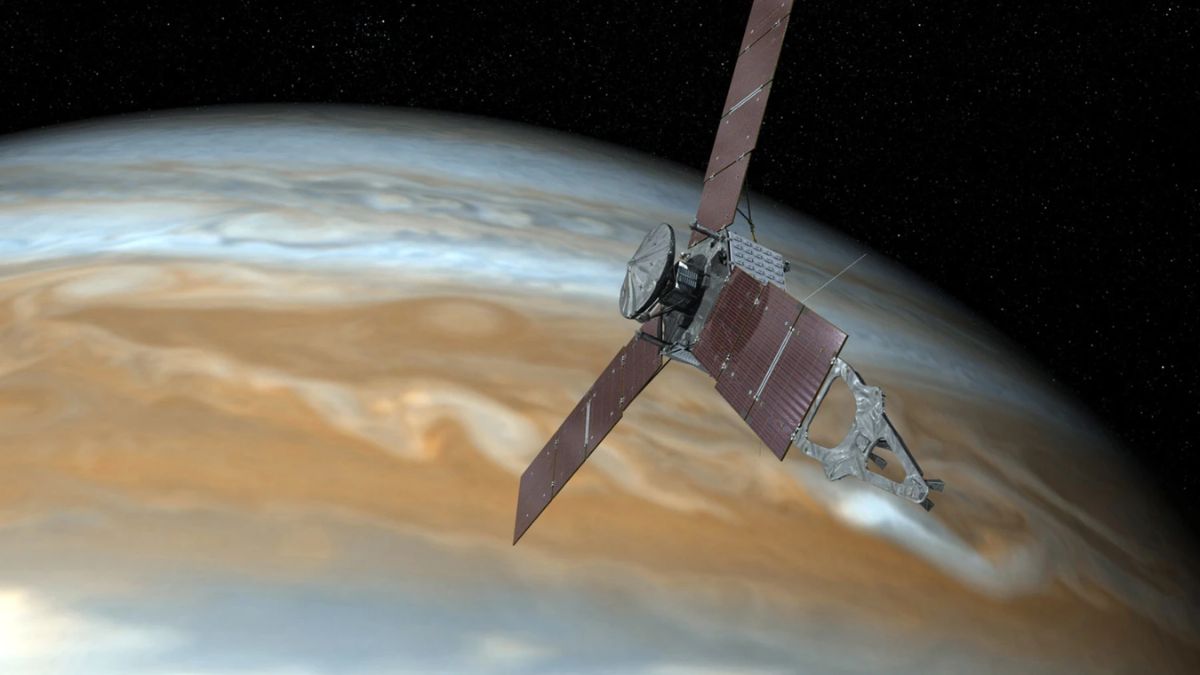
NASA launched the Juno spacecraft in 2011, and it has been orbiting Jupiter since 2016. Its mission? To study the gas giant’s atmosphere, magnetic field, and internal structure.
One of the mission’s most iconic tools is JunoCam, a camera that captures stunning images of Jupiter and its moons. While it was added mainly to engage the public, it turned out to be scientifically useful too. The only problem? It wasn’t built to last long.
Problem
JunoCam was placed outside the spacecraft’s main protective shell, which made it vulnerable to Jupiter’s intense radiation. When it was first designed, NASA expected it to survive for about 400 days—only eight orbits around Jupiter.

But the camera surprised everyone by surviving 46 full orbits. That is, until the 47th orbit when it started to act strangely. The images it sent back were corrupted, glitched, and incomplete. Scientists traced the issue to a radiation-damaged voltage regulator, a part that controls how much electricity the camera gets.
Impossible
Here’s the tricky part: Juno is currently orbiting Jupiter, almost 600 million kilometers away from Earth. That means no one can fly out to fix it, swap parts, or press a reset button. Any solution had to be done remotely—and carefully.
So what could they do?
Trick

The engineers at NASA tried something risky: thermal annealing. It’s a process used to repair radiation damage in electronics by heating the hardware, then letting it cool down slowly.
They sent a command telling the spacecraft to heat the camera’s internal components to about 25°C (77°F)—a lot warmer than usual for a deep-space device. After reaching the temperature, they let it cool again.
And somehow, it worked. The images came back clear and sharp, as if nothing had ever gone wrong.
Setback
Sadly, the fix wasn’t permanent. After some time, the camera began failing again. The image quality dropped, and the photos became corrupted once more. NASA tried image processing tricks, but none of them helped.
So, they turned to heat again—but this time, they increased the temperature even more (though they didn’t say by how much). Once again, the extreme heat trick worked, and JunoCam was ready just in time to take close-up shots of Jupiter’s volcanic moon Io in late 2023.
Lessons
This unusual fix did more than just save a camera—it opened NASA’s eyes to a whole new possibility. The success of thermal annealing means that other spacecraft could potentially use this method to heal from radiation damage.
It’s especially promising for future missions that head into high-radiation environments, like those around Jupiter, Saturn, or even deep space.
And the benefits go beyond space exploration. This method might also help defense systems, commercial satellites, and Earth-orbiting tech stay online longer, even in the face of radiation damage.
Status
As of the last update, JunoCam worked perfectly through the 74th orbit. But after that, the glitches came back. NASA hasn’t confirmed if they’ll try heating it again, or if JunoCam’s imaging days are officially over.
Still, the fact that they were able to bring the camera back twice using nothing but heat, from across the solar system, is a stunning success in itself.
Impact
Fixing a high-tech space camera with heat alone sounds like something out of a sci-fi movie, but it’s very real—and it’s changing the way engineers think about space maintenance. Juno’s mission proves that with enough creativity and the right tools, we can overcome even the toughest problems in the most distant places.
Who knows what future spacecraft might be able to heal themselves with a little heat?
FAQs
What is JunoCam?
It’s the camera on NASA’s Juno spacecraft orbiting Jupiter.
Why did the camera stop working?
Radiation damaged the voltage regulator inside the camera.
How did NASA fix the camera?
They used remote heat cycles to repair radiation damage.
Did the heat fix last permanently?
No, the issue returned after several orbits.
Why is this fix important?
It could help future missions and satellite maintenance.