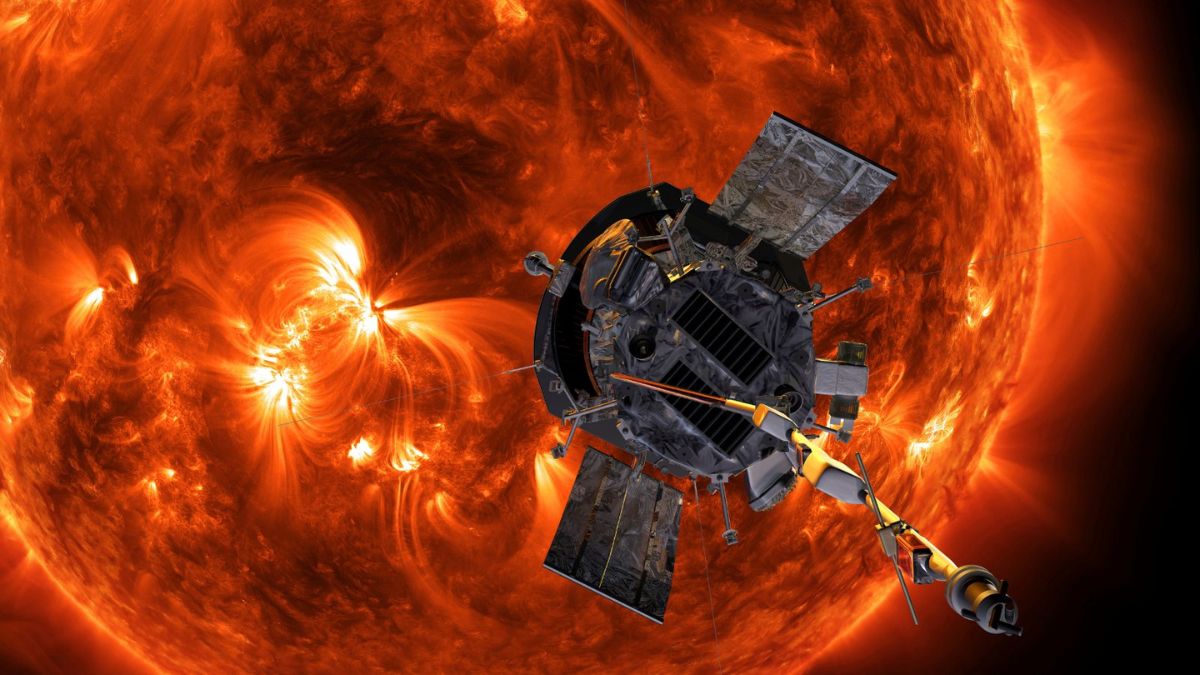
For decades, there was a question that no one could quite crack: why is the Sun’s corona — the outermost layer of its atmosphere — so much hotter than its surface? It sounds backward, doesn’t it? But that strange fact puzzled physicists for years. Now, thanks to NASA’s Parker Solar Probe, we finally have an answer. And it comes down to something called the helicity barrier.
It might sound like a term from a sci-fi movie, but this discovery is very real — and it changes everything we thought we knew about solar plasma, solar wind, and even how energy behaves in the universe.
Table of Contents
Helicity
So, what’s this helicity barrier all about? Think of it like an invisible wall floating around the Sun. Normally, in space, when plasma waves crash into each other from different directions, they mix, spread, and their energy dissipates. But near the Sun, that doesn’t happen.
Instead, the Parker Probe has shown that there’s a microscopic boundary that blocks this mixing. When the Sun’s magnetic field is super strong and the plasma pressure is low — a situation found in the corona — this barrier forms. The energy gets trapped and ends up heating things in a very unusual way.
That invisible wall is what scientists now call the helicity barrier.
Mystery
One of the weirdest things about the solar wind — the stream of charged particles the Sun shoots out into space — is that the protons are much hotter than the electrons. And for years, that just didn’t make sense. Basic physics says they should be about the same.
But now, with the discovery of this barrier, we’ve got a solid explanation. The barrier keeps the energy from spreading evenly. Instead, the protons hog most of it. That’s why they come flying out of the Sun at much higher energy levels.
Rare
Here’s the thing: this helicity barrier isn’t just floating around everywhere. It needs some very specific conditions to form — super hot plasma, low density, and intense magnetic fields. So far, the only place we’ve found all three together is in the solar corona.
That makes this a rare phenomenon. But it’s also incredibly useful. If we can understand how it works around the Sun, we can use the same ideas to understand other extreme environments in space, like black hole disks or high-energy nebulae.
Impact
Let’s get real for a second: this isn’t just cool space trivia. The Sun’s wild behavior has real effects on our daily lives. When the solar wind gets too strong, it can mess with satellites, GPS signals, communications systems, and even power grids here on Earth.
With this new knowledge, scientists can build better space weather models. That means we’ll have more accurate predictions when a solar storm is coming — which gives us more time to protect our tech-dependent world.
Probe
None of this would be possible without the Parker Solar Probe. This isn’t just another spacecraft doing a flyby. Parker was built to get closer to the Sun than anything before it. It’s flying through regions no human-made object has ever entered — and it’s surviving conditions that would destroy most machines.
What it’s detecting, like the helicity barrier, has never been seen in real space before. Up until now, this kind of solar plasma behavior only existed in computer models. But Parker is turning theory into evidence.
Breakthrough
This discovery is just the beginning. The Parker Probe is still on its mission, collecting more data and diving deeper into solar mysteries. Scientists now want to track how the helicity barrier changes at different distances from the Sun. They also want to see if this same barrier might appear in other places across the universe.
Every new piece of data could help us rewrite how we understand the behavior of energy in the most extreme environments. This isn’t just about one star — it could change how we understand many of them.
Surface vs Corona=
| Layer | Temperature (Approx.) | Mystery |
|---|---|---|
| Solar Surface | ~5,500°C | Cooler than expected |
| Solar Corona | ~1,000,000°C | Much hotter — until now unexplained |
| Cause | — | Helicity barrier discovered by Parker |
So, what started as a question with no answer has now become one of the most exciting breakthroughs in solar physics. The Sun, our nearest star, still has secrets — but now, thanks to Parker and the discovery of the helicity barrier, we’re finally learning to read its language.
And this? It’s only the beginning.
FAQs
What is the helicity barrier?
It’s an invisible boundary that stops plasma energy from mixing.
Why is the Sun’s corona hotter than its surface?
Because of the helicity barrier trapping heat near the corona.
What did the Parker Probe discover?
It found direct evidence of the helicity barrier near the Sun.
How does this affect Earth?
It helps improve predictions of solar storms that affect tech.
Can the helicity barrier exist elsewhere?
Possibly, in places with extreme plasma and magnetic fields.