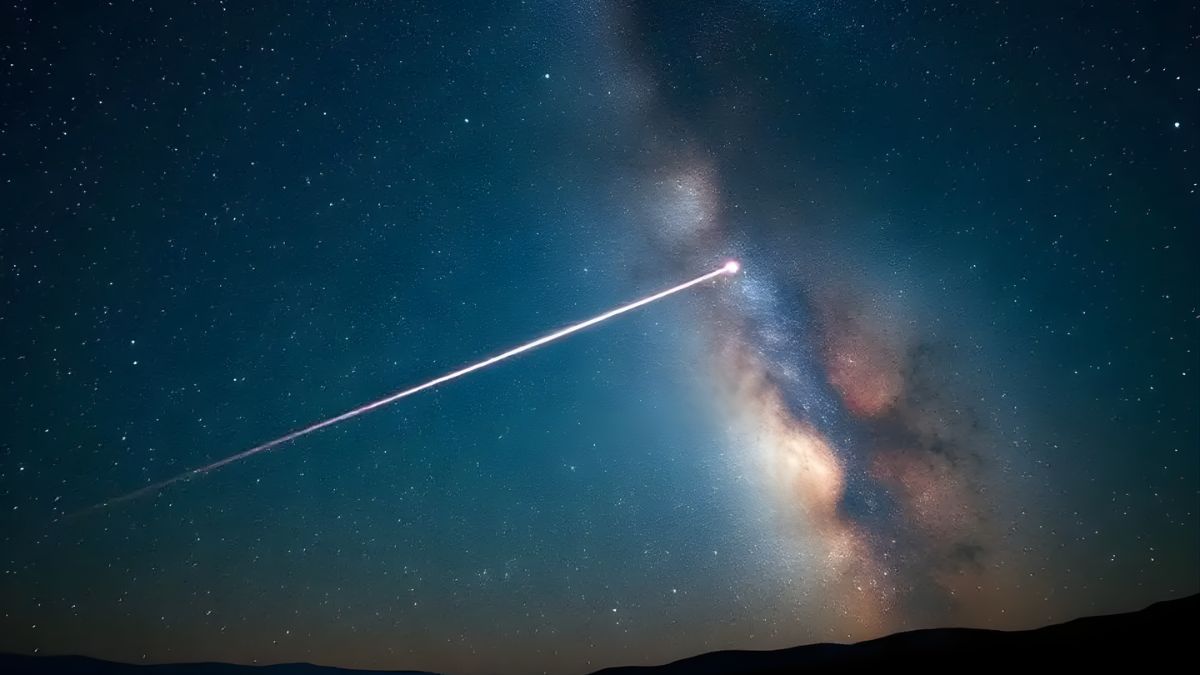
Can you imagine tracking the journey of a space rock that’s been drifting through the galaxy for 10 million years? That’s exactly what a group of scientists from Spain has done with comet 3I/ATLAS. According to Xabier Pérez Couto from CITIC at the University of A Coruña, this icy traveler is not just any ordinary comet — it’s an interstellar visitor and possibly a time capsule carrying secrets from another star system.
Table of Contents
Origins
The story begins far, far away — literally. This isn’t a comet born in our solar system. It was first detected on July 1 from Chile using the ATLAS system (Asteroid Terrestrial-impact Last Alert System), and quickly stood out as something special.
3I/ATLAS is the third interstellar object ever discovered, following in the cosmic footsteps of the mysterious ‘Oumuamua and the dusty 2I/Borisov. Like those before it, ATLAS is simply passing through, and won’t come any closer than 270 million kilometers from Earth. So, no, it’s not going to crash into us — just a calm flyby.
Unique
What makes it so fascinating is where it comes from. This comet is literally from another stellar system. And that’s why scientists are buzzing — because it means 3I/ATLAS carries material that was formed around a star that isn’t our Sun.
Xabier Pérez Couto puts it simply: each interstellar comet is like an open window into the history of the Universe. That’s not just poetic — it’s scientifically massive. This little icy wanderer holds untouched particles, minerals, and molecules that could tell us how planets formed in other systems, how early organic materials developed, and maybe even how life as we know it began.
Gaia
To uncover this comet’s ancient path, researchers used data from the European Space Agency’s Gaia mission. Think of Gaia as the ultimate star map — the most precise charting of the Milky Way we’ve ever had. It tracks the position, brightness, and movement of over a billion stars.
With Gaia’s data, the Spanish team “rewound” time using simulations and mathematical models. They managed to track 3I/ATLAS back millions of years to its probable origin outside our solar system. It’s like scrubbing back through cosmic history with a remote control.
Capsule
Comets have always been called frozen relics of the past. But interstellar comets are on another level. 3I/ATLAS is made of ancient ice and dust from a completely different system — maybe one that formed planets very differently than ours.
When scientists say it’s a “time capsule,” they mean it’s a sealed-off record of materials that existed before our solar system was even a thought. Studying it is like digging up alien fossils. You’re getting chemical fingerprints that could explain how different stars shape the building blocks of life.
It’s also throwing a wrench into our existing theories about how solar systems are formed. If 3I/ATLAS is made of stuff we haven’t seen before, it means our current models might need a rewrite.
Spain
Let’s take a moment to appreciate Spain’s growing role in space science. CITIC and the team in A Coruña are showing the world that high-level space research isn’t just happening at NASA or ESA headquarters.
Their models and simulations allow them to do something incredible — reverse-engineer the path of a rock that traveled across the galaxy, something we can’t observe directly. And every simulation they run gives us a new clue about the Universe.
They aren’t just observing; they’re building a galactic storyline.
Future
The European scientific community, including ESA, is already putting interstellar objects on their priority list. These comets are like postcards from across the galaxy, delivering snapshots of how other parts of space operate.
After 3I/ATLAS passes by, it will continue its journey into deep space. But it leaves behind a wealth of information and inspiration. It’s a small visitor with a big story, reminding us of how much there’s still left to explore.
Every time we look up, whether through a telescope or with the naked eye, we’re continuing a journey humans started thousands of years ago — trying to know our place in the Universe. And maybe, just maybe, 3I/ATLAS is another tiny step toward answering that.
FAQs
What is comet 3I/ATLAS?
An interstellar comet passing through our solar system.
Where was 3I/ATLAS discovered?
It was first spotted from Chile using the ATLAS system.
Will it hit Earth?
No, it will pass safely 270 million km away.
Why is 3I/ATLAS important?
It holds material from another star system — a space time capsule.
How did scientists trace its origin?
Using ESA’s Gaia data and simulation models.