Our universe never runs out of surprises, and the James Webb Space Telescope (JWST) is making sure we don’t miss any of them. If you haven’t heard, JWST is the most powerful telescope humanity has ever built, and it’s already rewriting what we thought we knew about the cosmos.
Its latest discovery? A galaxy so ancient, its light has taken 13.4 billion years to reach us. Let that sink in—we’re looking at a snapshot from when the universe was just 2% of its current age. The galaxy is called JADES-GS-z14-0, and it’s officially the most distant galaxy we’ve ever seen.
Table of Contents
Telescope
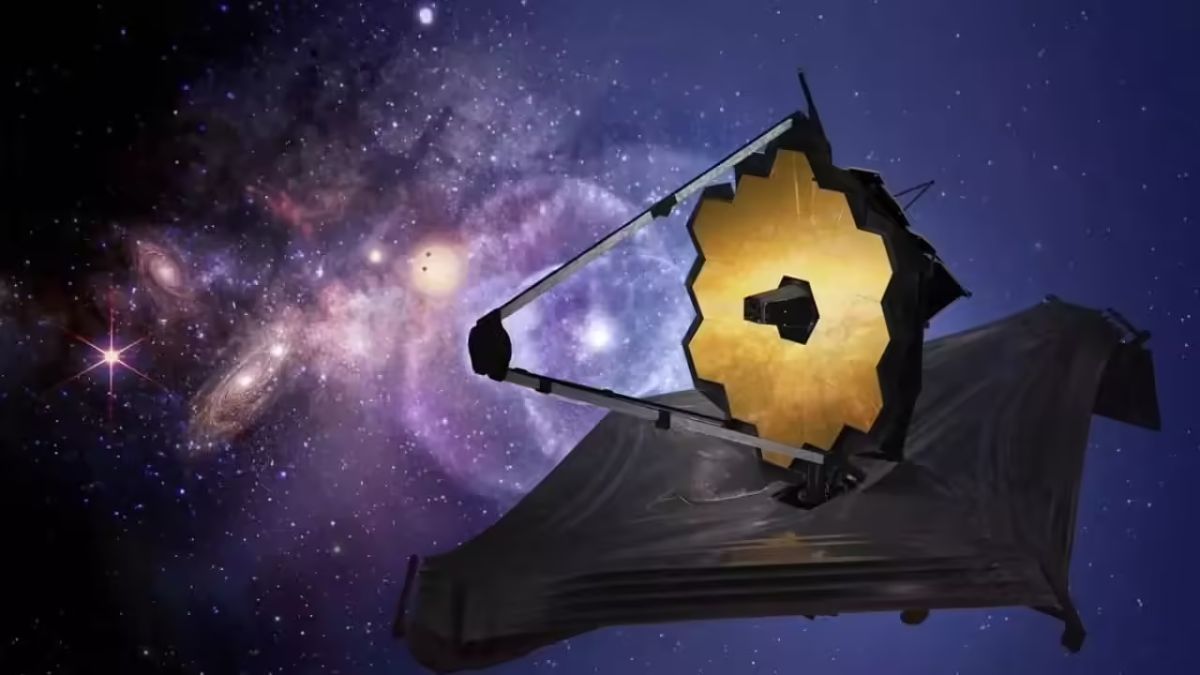
Before we get into the galaxy, let’s talk about the machine that made it all possible. The James Webb Space Telescope is the successor to the legendary Hubble, but it’s no simple upgrade. While Hubble focused on visible and ultraviolet light, JWST is all about infrared. Why? Because the farther an object is in space, the more its light gets stretched—or redshifted—into the infrared spectrum. That’s exactly where JWST shines.
Launched in December 2021, JWST is parked 1.5 million kilometers from Earth at a spot called the L2 Lagrange Point. It carries a massive 6.5-meter-wide mirror, allowing it to capture light from incredibly faint and distant objects—like JADES-GS-z14-0.
Discovery
So how did scientists spot this ancient galaxy? They used JWST’s Mid-Infrared Instrument (MIRI), which detects specific wavelengths of infrared light. In the case of JADES-GS-z14-0, MIRI picked up a strong signal at 7.7 micrometres—a clear fingerprint of ionized oxygen.

Here’s where things get weird. Oxygen isn’t supposed to be there—not in a galaxy this young. According to existing models, oxygen forms only inside massive stars and gets released into space when those stars die in explosive supernovae. But if we’re seeing oxygen in JADES-GS-z14-0, that means there had already been several generations of stars forming and dying very early in the universe. That’s a serious puzzle for astronomers.
Galaxy
Let’s break down what makes JADES-GS-z14-0 so special:
| Feature | Detail |
|---|---|
| Redshift (z) | 14.3 (most distant galaxy ever observed) |
| Distance | Light took 13.4 billion years to reach us |
| Age of Universe Then | Just 2% of its current age |
| Estimated Mass | 500 million times the mass of our Sun |
| Structure | Larger and more extended than expected |
What’s stunning is that it’s not just a speck in the sky. JADES-GS-z14-0 has a visible structure, suggesting it’s more developed than we’d expect for such an early period in cosmic history.
Oxygen
The real shocker is the presence of oxygen. It doesn’t just break the rules—it throws the textbook out the window. If this galaxy contains oxygen, and if oxygen only comes from the life cycle of stars, that means this galaxy already had a rapid-fire history of star birth and death—way faster than we thought possible.
It suggests that galaxies like this could have formed and evolved at lightning speed, challenging everything we believed about the early universe.
Questions
This discovery doesn’t just blow our minds—it raises major questions:
- Are there more galaxies like JADES-GS-z14-0 hiding out there?
- Is our current theory of galaxy formation missing something?
- Could there be a completely different process driving galaxy evolution in the early universe?
As Jakob Helton, lead author of the study, put it: “The fact that we found this galaxy in a tiny region of the sky means there should be many more out there.”
Future
This is only the beginning. If JWST can uncover a galaxy like this in such a small corner of the sky, imagine what else is out there. Each new discovery adds a piece to the cosmic puzzle and might one day help us understand how everything came to be.
The universe, it turns out, still has plenty of secrets. And thanks to JWST, we’re closer than ever to unlocking them.
FAQs
How old is the JADES-GS-z14-0 galaxy?
Its light took 13.4 billion years to reach Earth.
What does JWST stand for?
James Webb Space Telescope.
What makes JWST special?
It observes in infrared, revealing distant galaxies.
Why is oxygen surprising in this galaxy?
Because it’s too early for oxygen to exist there.
What is redshift z=14.3?
It indicates extreme distance and age of the galaxy.