Our universe never stops surprising us. Just when we think we’ve got things figured out, space throws us a curveball. Recently, astronomers detected something truly puzzling—a strange light signal from a distant corner of the cosmos. No, it’s not aliens (sorry, UFO fans), but what it is might be even more fascinating.
Let’s break down what this mystery is all about and why it’s got scientists all over the world buzzing with excitement.
Table of Contents
Signal
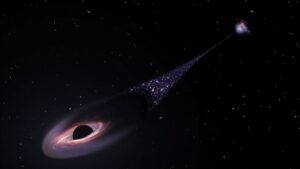
The strange light is known as a Fast Radio Burst, or FRB for short. Specifically, it’s called FRB 20190208A, and it was detected coming from a faint, tiny dwarf galaxy a mind-blowing 7 billion light-years away.
What’s so shocking? Well, FRBs usually come from massive galaxies that are actively forming stars. This one? Not even close. It came from a weak little galaxy that astronomers didn’t expect to be producing anything this powerful.
Mystery
Fast Radio Bursts are intense, super-short explosions of energy. They last just a few milliseconds, but in that brief time, they release more energy than the Sun does in days. First discovered in 2007, FRBs have become one of space’s most baffling phenomena.

They appear suddenly, from random directions in the sky, and then disappear again. Many never repeat, making them even harder to study.
What’s even more curious is that some FRBs repeat over time, while others don’t. Some come from rich, active galaxies. Others, like this new one, seem to come out of nowhere.
Hypotheses
So, what could be causing these cosmic flashes? Scientists have several theories, but nothing is confirmed yet. Here are the leading ideas:
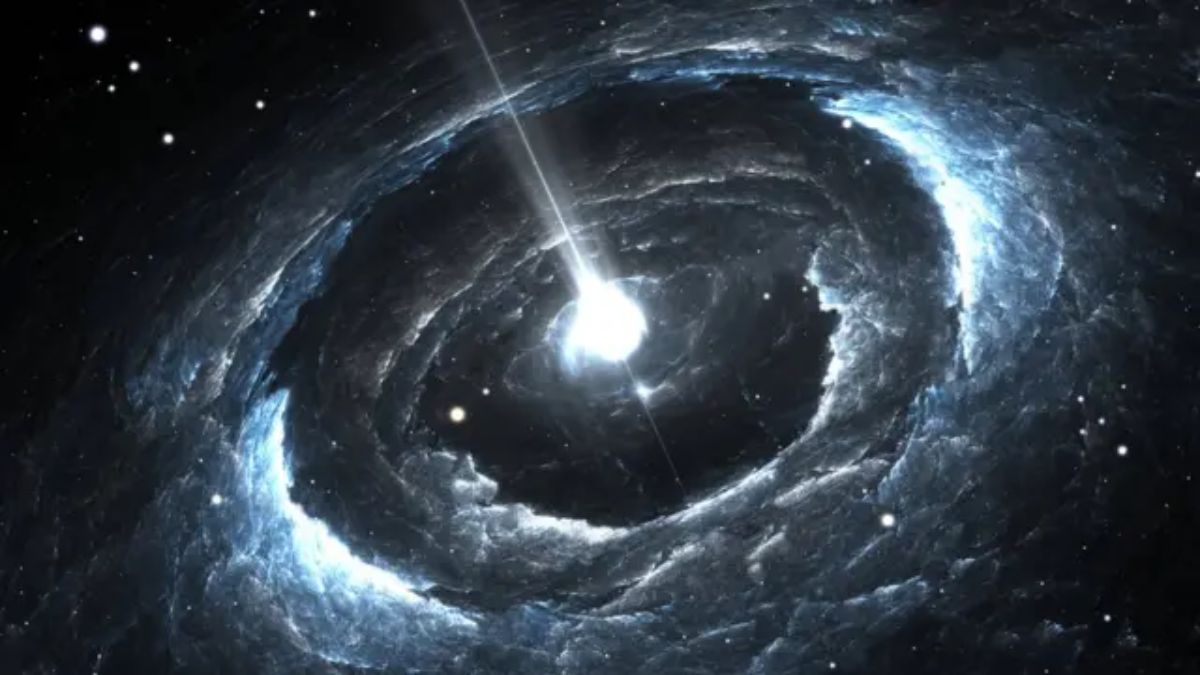
- Neutron Stars (Magnetars): These are dense, collapsed stars with insanely strong magnetic fields. A powerful magnetic shock or collapse might release a burst like an FRB.
- Stellar Collisions: When two stars—especially neutron stars—collide, they can release huge amounts of energy, possibly triggering an FRB.
- Unknown Physics: This theory simply admits what we all suspect—there may be something going on that we haven’t discovered yet. A missing piece of the cosmic puzzle.
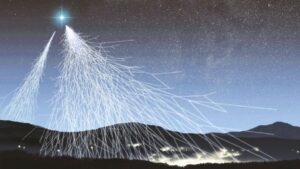
Astronomer Danté Hewitt from the University of Amsterdam commented that this specific burst came from “one of the least dense galaxies we’ve observed,” which made it even more surprising.
Aliens?
Let’s get it out of the way—every time a weird space signal is detected, the internet explodes with alien theories. Could it be a message from another civilization?
Tempting as that idea is, scientists aren’t buying it. There’s no solid evidence linking FRBs to intelligent life. Most researchers agree the signals have a natural astrophysical cause—one we just haven’t totally figured out yet.
That doesn’t mean aliens are impossible, of course. But in this case, the boring explanation might actually be more amazing. It shows just how much we still don’t know about the forces and objects floating out there in deep space.
Discovery
This discovery is more than just another strange blip in the night sky—it’s a reminder of how little we truly understand about the universe. A tiny galaxy that no one paid much attention to just screamed across the universe with a blast of energy so strong that it traveled for billions of years to reach us.
If that’s not humbling, what is?
Astronomers now have even more motivation to search for similar bursts and investigate dwarf galaxies more closely. Who knows what else is hiding in those faint, overlooked corners of the cosmos?
Every discovery like this reminds us that space is far from silent—it’s constantly buzzing, bursting, and whispering secrets across time. And we’ve only just started to listen.
FAQs
What is FRB 20190208A?
A fast radio burst from a galaxy 7 billion light-years away.
Where do FRBs usually come from?
Most come from massive, star-forming galaxies.
What causes FRBs?
Possibly magnetars, stellar collisions, or unknown physics.
Is FRB 20190208A from aliens?
No evidence supports an alien origin, says scientists.
Why is this FRB special?
It came from a faint dwarf galaxy, which is rare.