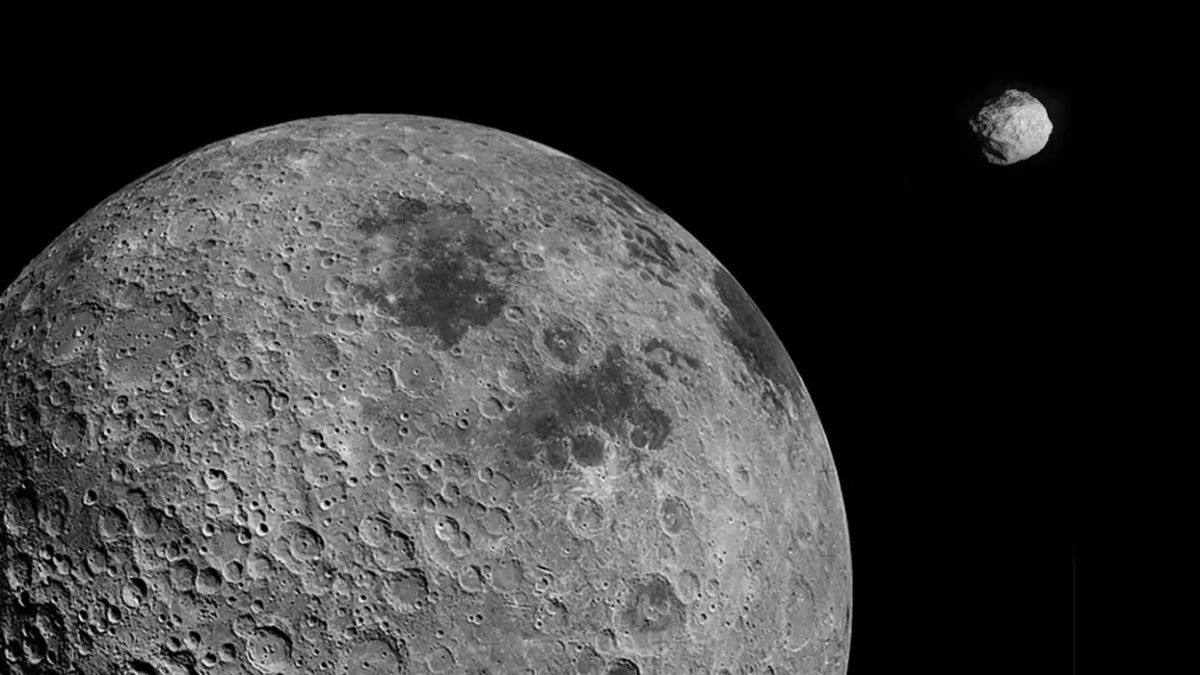
A newly discovered asteroid named 2024 YR4 has stirred up excitement among scientists—not because it’s a threat to Earth, but because it might crash into the Moon. Initially, this space rock was on a potential collision path with Earth, raising some eyebrows at NASA and the European Space Agency (ESA). But after further observation, the asteroid shifted targets… and now has a 3.8% chance of hitting the Moon in 2032.
No, it’s not dangerous. But yes, it’s fascinating. Here’s why.
Table of Contents
Asteroid
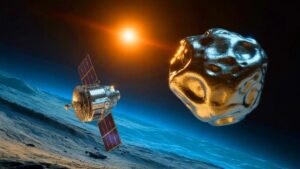
2024 YR4 is a relatively small asteroid, between 53 and 67 metres wide. That’s large enough to cause damage if it were to hit Earth, but thankfully, recent trajectory data has ruled that out. Originally, the asteroid had a 3.1% chance of impacting Earth, which for scientists, is a number that deserves attention.
But after more precise measurements—especially thanks to the James Webb Space Telescope—experts recalculated the orbit and breathed a sigh of relief. Earth is safe. However, the Moon’s chances of taking the hit have gone up slightly, now sitting at 3.8%.
Impact
So… why is everyone suddenly rooting for a space rock to crash into the Moon?
Simple: because we’ve never seen anything like it before. Despite the Moon being covered in craters from countless impacts over billions of years, humanity has never witnessed a collision of this scale live. If 2024 YR4 does strike, it would be the first time we observe an asteroid hitting the Moon in real time—and that makes it a golden opportunity for science.
Professor Mark Burchell, an expert in planetary science, has even said that such an impact might be visible with a decent pair of binoculars. Imagine watching history unfold… from your backyard.
Opportunity
Here’s what makes this event so scientifically valuable:
- The Moon has no atmosphere, so the asteroid wouldn’t burn up like it would on Earth.
- The impact would directly hit the surface, creating a new crater and possibly scattering debris over kilometres.
- Scientists could study crater formation, ejecta patterns, and seismic activity across the Moon’s surface.
- It would help refine models of how celestial bodies respond to collisions.
It’s basically a giant, natural experiment—with no risk to humans.
Observation
NASA and ESA both view this as a test case for planetary defense systems. Remember the DART mission in 2022? That was a deliberate attempt to deflect an asteroid. In this case, they wouldn’t intervene—but they would get to observe how a real collision plays out, and compare it to simulations and lab models.
There’s no need to send probes or robots—just set up the telescopes, hit record, and wait.
Risk
Should we be worried?
Not at all. NASA has made it clear: there’s a 96.2% chance that nothing will happen. The Moon is not in danger. Earth is not in danger. And the asteroid is far too small to have any real effect on the Moon’s orbit or structure.
But even with such a low probability, astronomers and space agencies are keeping an eye on it. Because in the world of science, even a 3.8% chance is worth watching—especially when it could bring insights we’ve never had before.
What if?
If 2024 YR4 does hit the Moon in 2032:
- Everyone with a telescope (or good binoculars) may get to watch it happen.
- It would provide the best data yet on how asteroid impacts work on airless bodies.
- It might inspire a new generation of astronomers and planetary scientists.
- And of course, it would be a once-in-a-lifetime skywatching event.
In a way, the asteroid has gone from being a potential threat… to being a possible gift for science.
Let’s Wait
So now, all we can do is wait and watch.
Astronomers will continue refining 2024 YR4’s orbit over the next few years. As we get closer to 2032, we’ll know more precisely whether the Moon will take the hit or not. In the meantime, keep your binoculars handy, and maybe start marking your calendar.
After all, this might just be the most exciting thing to happen in the sky that year—and you could have front-row seats.
FAQs
Will asteroid 2024 YR4 hit Earth?
No, it has a 0% chance of impacting Earth.
What are the chances it hits the Moon?
Currently, there’s a 3.8% chance of lunar impact.
When would the impact happen?
If it happens, it would be in the year 2032.
Would it be visible from Earth?
Yes, potentially even with binoculars.
Why is this scientifically important?
It could be the first live observation of a lunar impact.