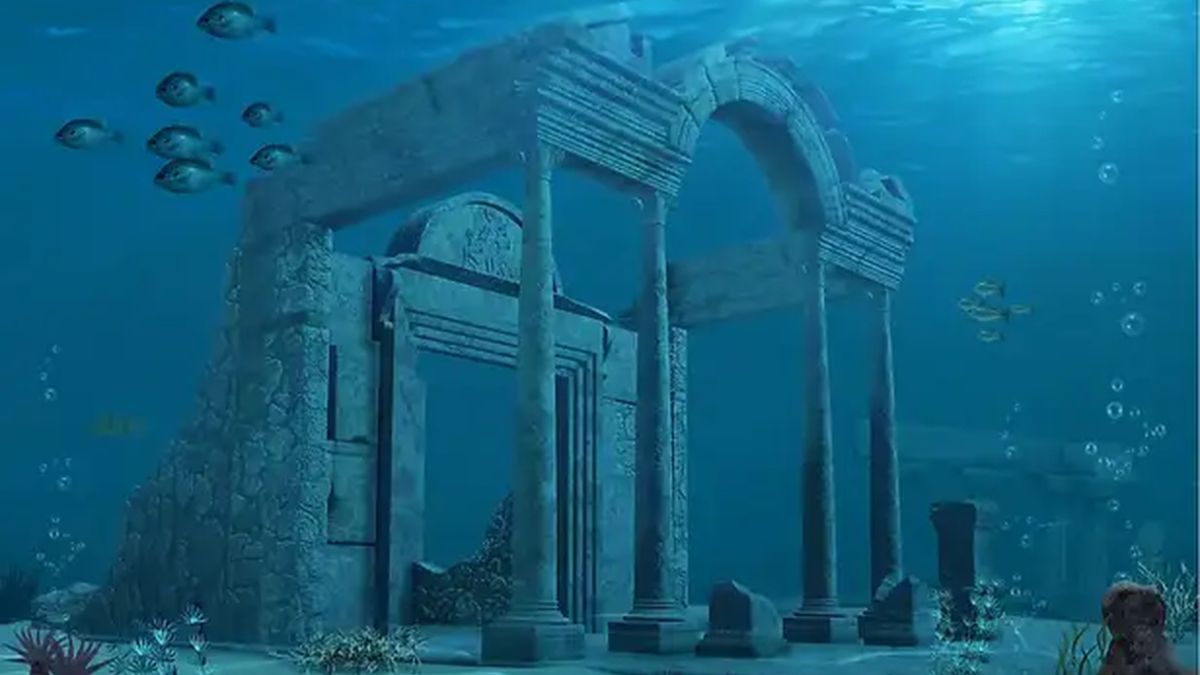
The search for Atlantis, the mythical sunken city described by Plato, has captivated dreamers, scientists, and explorers for centuries. Now, a group of Spanish researchers has reignited the debate with a discovery that could change everything. Deep beneath the waters off the coast of Lanzarote, in the Canary Islands, they’ve found submerged geological formations that match the characteristics of what might have once been inhabited islands. Could these be the real remains of Atlantis?
The Atlantis Project, led by the Geological and Mining Institute of Spain (IGME-CSIC), has found structures that include ancient beaches, coastal dunes, and even cliffs—perfectly preserved under 2,500 meters of water. The excitement is real, but so is the scepticism. Is this the greatest archaeological discovery of the century, or just another underwater mystery?
Table of Contents
Atlantis

Let’s go back to the beginning. Atlantis was first described over 2,000 years ago by the Greek philosopher Plato in his dialogues Timaeus and Critias. According to him, Atlantis was a powerful and advanced civilization that existed beyond the Pillars of Hercules—which we now know as the Strait of Gibraltar.
Plato painted a picture of a paradise: an enormous island with cities arranged in concentric circles, golden temples, exotic animals, lush gardens, and cutting-edge technology for its time. Atlantis tried to conquer other lands, but after a failed attempt against Athens, it was swallowed by the sea in a single day and night of catastrophes.
The story has inspired everything from books to movies to wild conspiracy theories. But what if it wasn’t just a myth?
Evidence

The new underwater findings suggest that there may be truth buried under centuries of legend. Samples collected by robotic submersibles in the Canary waters show signs of ancient volcanic activity, coastal erosion, and even sediment patterns that indicate the area was once above sea level.
These geological formations could have been part of a now-submerged island chain. If people once lived there and witnessed the land disappearing into the ocean, it’s easy to imagine how their story evolved into the myth of Atlantis over time.
Structure
Here’s what scientists have found so far:
| Aspect | Details |
|---|---|
| What was found | A massive underwater structure with patterns resembling city blocks |
| Location | Near Lanzarote, Canary Islands, Atlantic Ocean |
| Why it matters | Could be linked to Plato’s story of Atlantis |
| Reactions | Split between enthusiasm and academic caution |
| Scientific view | Possibly natural formations or ancient seabed shifts |
| Public impact | Huge buzz online, lots of theories and excitement |
| Next steps | More detailed exploration and dating of the formations |
| Cultural context | Tied to Plato’s account of a lost civilization swallowed by the sea |
Theory

Plato described a rich society with access to gold, silver, and exotic animals—something not easy to prove with rocks alone. But the presence of entire landmasses now submerged, and evidence they were once dry and possibly inhabited, adds weight to the idea that a real event inspired the Atlantis legend.
Marine geologist Luis Somoza, who leads the project, explains that lava-solidified rocks found at the site suggest major volcanic eruptions. These could have led to the collapse and sinking of large island areas—exactly the kind of catastrophic event that could spark a myth.
Glaciation
Another factor? The last glaciation. During that period, sea levels were dramatically lower. As the Earth warmed and glaciers melted, sea levels rose, slowly covering coastal areas and entire islands.
If people had been living there, their homes and lands could have been swallowed by rising water. It’s not hard to see how their descendants might remember such a disaster through stories passed down over generations.
Myth
So, was Atlantis real?
That’s still uncertain. No artificial structures like temples or roads have been found yet, but scientists say the area could have supported life. It’s not proof of a lost utopia, but it is enough to keep researchers curious and the debate alive.
If anything, this discovery encourages a new way to look at ancient myths—not just as stories, but as echoes of real events distorted through time and imagination.
Future
What happens next?
Researchers plan to continue collecting samples, mapping the underwater terrain, and using carbon dating to determine how long ago the islands were submerged. If they can match those dates with events from ancient history, we might get closer to understanding whether Plato’s story was based on reality—or pure fiction.
Even if it’s not Atlantis, the discovery of lost islands and potential human presence in the area thousands of years ago is a major step forward in understanding our planet’s forgotten past.
And maybe, just maybe, the myth was more real than we thought.
FAQs
Where were the structures found?
Near Lanzarote in the Canary Islands, underwater.
Could this really be Atlantis?
It’s possible, but not confirmed yet.
Who led the research project?
Marine geologist Luis Somoza from IGME-CSIC.
What evidence supports the theory?
Submerged islands, volcanic activity, and erosion patterns.
What’s next for the research?
Further exploration and dating of the underwater formations.