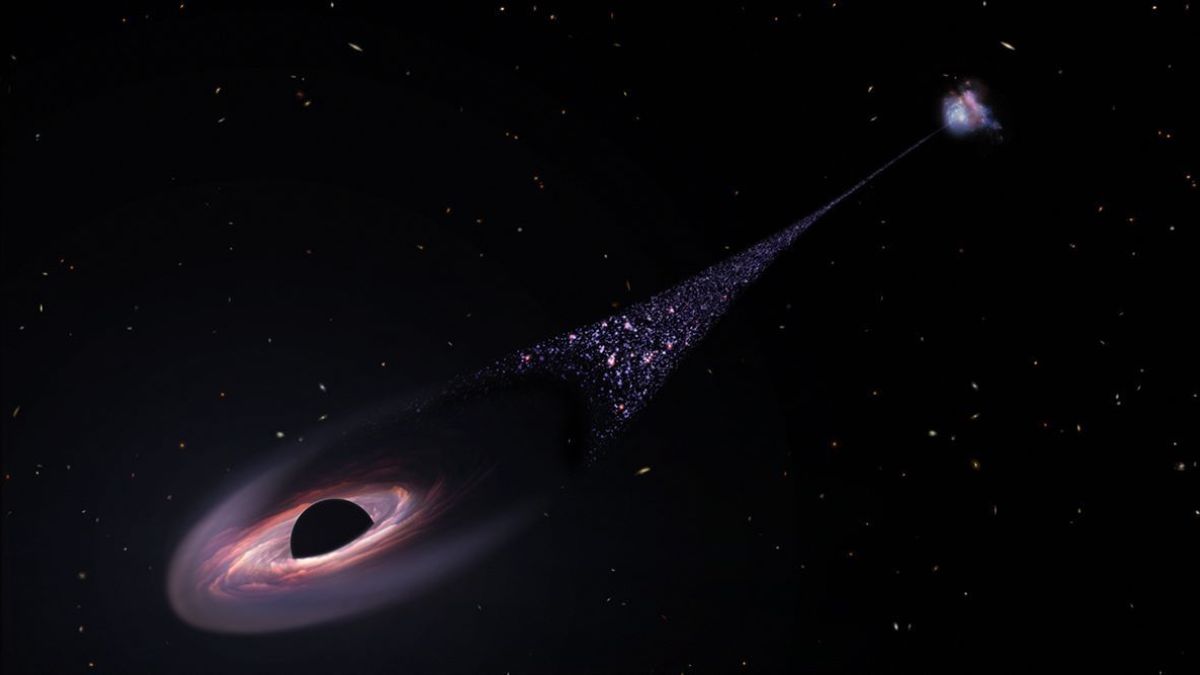
NASA’s latest discovery sounds like something out of a sci-fi thriller. A strange, high-velocity object—now nicknamed A11pl3Z—is hurtling through space at nearly 245,000 kilometers per hour, on a path that’s sending it straight toward our solar system. The find has astronomers both fascinated and slightly baffled. It doesn’t act like a comet, it doesn’t orbit like an asteroid, and its speed makes even interstellar travelers like ʻOumuamua look sluggish.
Table of Contents
What NASA Detected
According to data from NASA’s Asteroid Terrestrial-impact Last Alert System (ATLAS), A11pl3Z was first detected on June 25, 2025, moving at a speed that immediately raised eyebrows. Objects traveling this fast are usually not bound by the Sun’s gravity—meaning they’re just passing through, on a one-way trip from deep interstellar space.
NASA’s early models show A11pl3Z following a hyperbolic trajectory, meaning it entered our solar system from beyond and will exit again, likely never to return. Its projected route takes it near Mars in October 2025, and at its closest to Earth in December 2025—but don’t worry, the planet will be on the opposite side of the Sun at that time.
For now, scientists classify it as an interstellar object—only the third ever confirmed, after ʻOumuamua (2017) and 2I/Borisov (2019).
You can view NASA’s latest orbital updates directly on the Jet Propulsion Laboratory’s Small-Body Database.
What Makes A11pl3Z So Unusual

Most comets and asteroids follow predictable orbits around the Sun. A11pl3Z doesn’t. It’s moving far too fast, with a path that cuts clean through the solar system like a skipping stone. Even stranger—it’s huge. Early radar readings suggest a size between 10 and 20 kilometers wide, making it potentially one of the largest interstellar objects ever detected.
But here’s the kicker: it doesn’t have a visible coma or tail, the glowing halo of gas and dust that defines comets. That leaves astronomers scratching their heads—how does something that big, moving that fast, stay so dark and quiet?
Possible Explanations
| Hypothesis | What It Means | Likelihood (So Far) |
|---|---|---|
| Dormant Comet | A comet whose icy materials already evaporated in another star system | High |
| Rocky Interstellar Asteroid | Similar to ʻOumuamua, mostly rock or metal | Moderate |
| Fragment of a Rogue Planet | A rare chunk of planetary material ejected long ago | Low but exciting |
| Artificial Object | Extremely unlikely—no evidence of propulsion or radio signal | Almost zero |
According to ESA planetary scientist Richard Moissl, “A cometary origin still fits the data best, but if A11pl3Z turns out to be something else, it would challenge many of our assumptions about how solar systems evolve.”
Both NASA’s James Webb Space Telescope (JWST) and Chile’s Vera C. Rubin Observatory are now tracking A11pl3Z to capture its thermal signature and spectral data. Results from those observations are expected by early November.
A Quick Refresher: What Counts as a Comet?
A comet is essentially a frozen time capsule—a mix of rock, dust, and volatile ices. When it nears the Sun, those ices vaporize, creating that spectacular glowing tail we see in the night sky.
Most comets come from the Oort Cloud or Kuiper Belt, regions billions of kilometers from Earth. When something arrives from outside those boundaries, it’s categorized as interstellar—a traveler from another star system entirely.
That’s why A11pl3Z is such a big deal. It’s not “ours.” It’s a visitor from somewhere else in the galaxy.
Why This Discovery Matters
Finding A11pl3Z isn’t just another cool astronomy headline—it’s a scientific goldmine. Interstellar objects are messengers from other planetary systems. Studying them can reveal what elements exist in far-off star nurseries and even hint at how life’s building blocks—like carbon compounds—spread across the galaxy.
Astronomer Mark Norris, part of NASA’s interstellar monitoring team, told reporters that “A11pl3Z might just be one of thousands of objects drifting silently through our neighborhood. We’re only now starting to detect them.”
NASA estimates that as many as 10,000 interstellar objects could currently be passing through the solar system undetected—most too small or too dim to spot. The detection of A11pl3Z, therefore, isn’t just a lucky break; it’s a sign our observation technology is finally catching up.
Could It Pose Any Risk to Earth?
No. Despite the buzz online, A11pl3Z poses zero threat. Its closest approach in December 2025 still leaves Earth safely shielded by roughly 300 million kilometers of space and, conveniently, the Sun itself.
The object will likely swing past, loop around once due to the Sun’s gravity, and then shoot back out toward the stars by mid-2026.
If you want to track its journey, NASA regularly updates trajectories at nasa.gov/asteroids-comets-meteors.
What We Might Learn From A11pl3Z
If JWST or other observatories detect unusual chemical fingerprints—say, complex organics or metals not found in our solar system—it could reshape what we know about interstellar chemistry.
That means A11pl3Z isn’t just another rock—it’s a time capsule from another star system, possibly billions of years old. Each data point helps scientists test theories about how solar systems form, how planets are ejected, and how materials travel between stars.
This visitor might not stay long, but its presence will keep telescopes busy for months—and its data could fuel research for decades.l.
FAQs
What is A11pl3Z?
A newly detected interstellar object speeding into our solar system, first spotted by NASA’s ATLAS system in June 2025.
How fast is it moving?
Roughly 245,000 km/h, faster than most known asteroids or comets.
Is there a chance it could collide with Earth?
No. It will safely pass by, with Earth on the opposite side of the Sun.
Is it a comet or an asteroid?
Still under study. It lacks a visible tail, suggesting it might be a dormant comet or rocky interstellar body.
Why is it important?
Studying it could reveal new information about interstellar materials, star system formation, and potentially the origins of life.