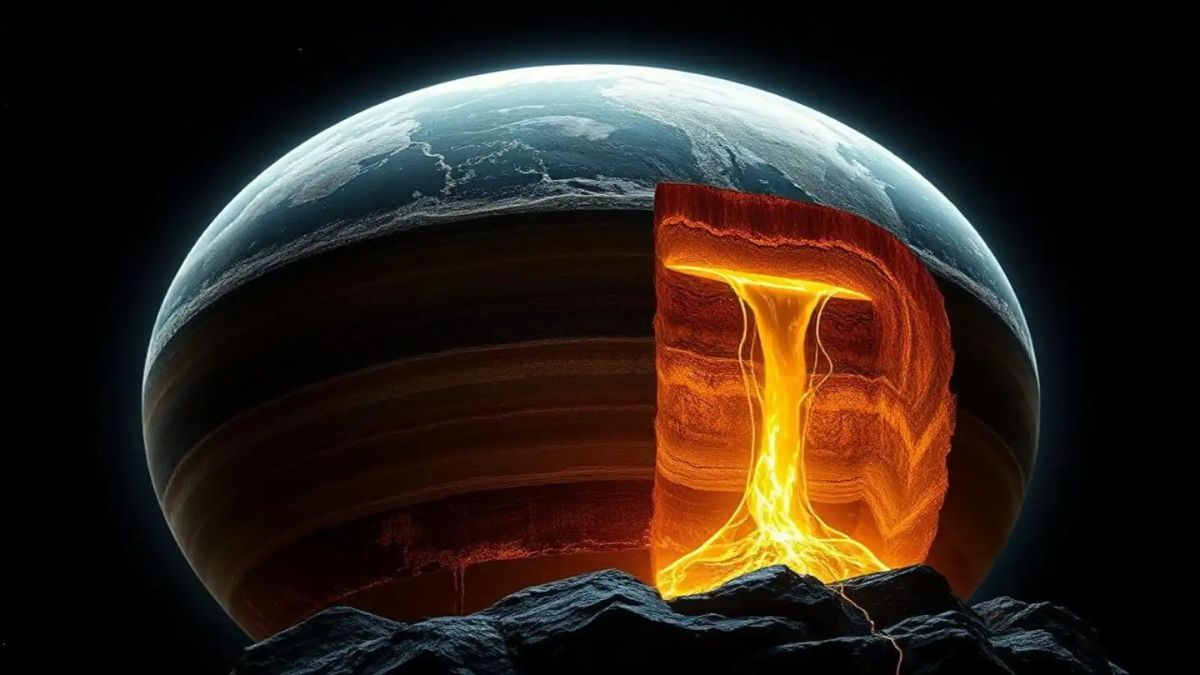
The Earth has always kept a few secrets up its sleeve, but this new discovery is pure gold—literally. Scientists have found that Earth’s core is rich in gold and that this precious metal may be making its way up to the surface. That’s right, the next time you spot a volcano, you might just be looking at a molten gold delivery system in action.
Let’s cut (not literally) into what this means for science, our understanding of the planet, and the future of planetary research.
Table of Contents
Structure

To understand how gold could move from the Earth’s center to the surface, we need to start with how our planet is built. Earth is made up of three main layers: the crust, the mantle, and the core.
- The crust is the outermost layer, where we live, and where you’ll find oceans, continents, and mountains.
- Beneath that is the mantle, made of hot, slow-moving, molten rock.
- At the center lies the core, which is super hot and packed with heavy metals—including gold.
The deeper you go, the hotter and more pressurized it gets. That’s why the core is considered one of the most extreme environments on Earth.
Discovery
So how did scientists figure out what’s going on so far below the surface? German researchers were analyzing volcanic rocks when they stumbled upon something unexpected: a rare metal called ruthenium.

Now, ruthenium is already valuable, but this version had a strange isotope—a type of atom variation—that only exists deep in the Earth’s core. The presence of this isotope in volcanic rocks found near the surface shocked the scientific community. It was like finding a fingerprint from the planet’s core in a place it shouldn’t be.
Journey
But how does gold—and other heavy metals—travel from the core to the surface? The answer lies in a natural process called convection. Here’s how it works:
- Heat causes molten rock in the mantle to rise and move.
- As the mantle churns, it picks up trace amounts of metals from the core.
- These rocks, now loaded with metals like gold and platinum, slowly rise toward the crust.
- Eventually, they reach areas near volcanoes and may even be expelled in lava.
So yes, volcanoes might not just spew lava—they could be pushing out microscopic amounts of gold too.
Importance
You might be wondering: is this just a cool fact, or does it really matter? It matters—a lot.
For years, scientists believed the Earth’s core was sealed off from the rest of the planet. This discovery shows otherwise. It means that material from the core can travel upward, changing how we view the structure and behavior of the planet.
Knowing this process doesn’t just help us understand Earth—it also helps us study other planets. If metals can move like this here, maybe the same happens on Mars or Venus. It opens the door to new theories about planetary formation and evolution.
Goldrush?
Don’t grab a shovel just yet. Even though this discovery sounds like a golden opportunity, mining the Earth’s core is still science fiction. Digging that deep is impossible with today’s technology, and the journey alone would destroy any equipment we have.
Besides, the gold is coming up slowly through natural processes. Trying to interfere could mess with delicate geological systems. It’s better to let nature run its course and observe carefully.
Wonder
What makes this story fascinating is that the scientists didn’t set out to find gold or even study the Earth’s core. They were just examining volcanic rocks and stumbled upon the truth by accident. It shows how much we still don’t know about the planet we live on—and how powerful even small discoveries can be.
The more we look, the more we realize Earth is a living, breathing machine with moving parts that affect each other in complex ways. And just like that, something as ordinary as a lava rock turns into a window into Earth’s mysterious heart.
FAQs
Is there gold in the Earth’s core?
Yes, scientists believe it holds large amounts of gold.
Can gold travel to the surface?
Yes, via convection and volcanic activity.
How was this gold discovery made?
Through rare isotopes found in volcanic rocks.
Can we dig to the core for gold?
No, it’s impossible with current technology.
Why does this matter to science?
It changes our understanding of Earth’s structure.